

International trade moves fast. The last thing you want slowing you down is a misunderstanding over a contract term.
Incoterms, short for International Commercial Terms, are 11 globally recognised trade terms published by the International Chamber of Commerce (ICC). They define who is responsible for costs, risks and logistics at every stage of a shipment. Used correctly they protect both parties. Used incorrectly they can lead to unexpected costs, uninsured cargo and costly delays. This guide is our way of making sure you know all 11, so you can avoid the mistakes we at ISL see all too often.
Most mistakes come down to three things: assuming the other party is covering a cost or risk they are not, using the wrong term for the mode of transport, or agreeing a term without fully understanding what it means for that specific shipment.
The consequences are real. Unexpected invoices, uninsured cargo and customs delays are all avoidable with the right knowledge upfront. Choosing the right Incoterm is not a formality. It is a commercial decision that affects your costs, your risk and your relationship with your trading partner.
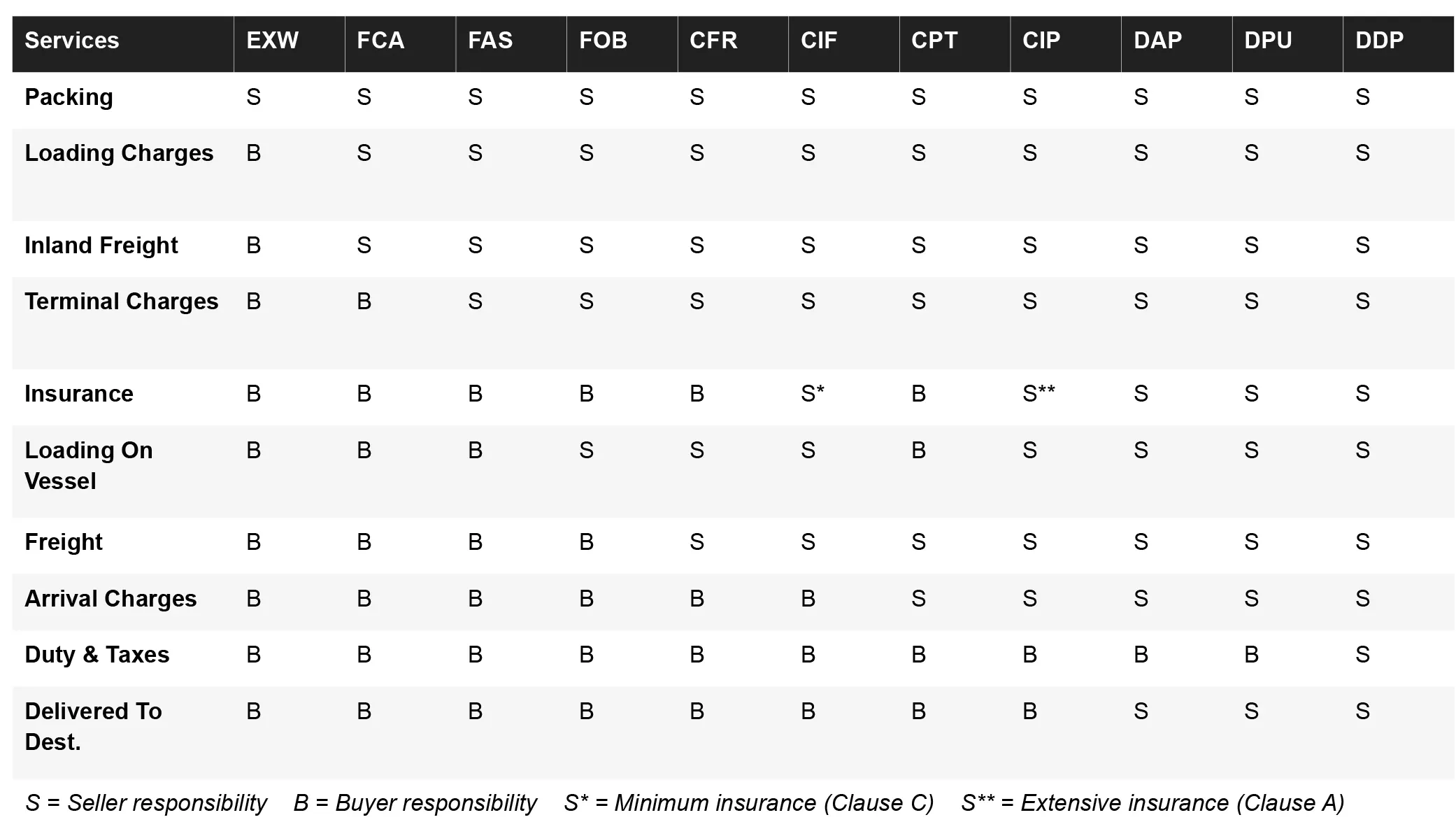
Incoterms 2020 Responsibility Matrix
The table below shows who is responsible for each stage of a shipment under each Incoterm. S = Seller, B = Buyer.
If you are unsure which term is right for your next shipment, feel free to reach out to ISL’s team at info@isltrinidad.com. We work with businesses globally every day, and getting these decisions right is exactly the kind of thing we are here for. For more on how cargo insurance fits into your shipment, find out about ISL’s Cargo Insurance services HERE
The 11 Incoterms 2020 Explained
Key Abbreviations
The following abbreviations appear frequently in shipping documentation and contracts. Use this section as a reference alongside your paperwork.
| Abbreviation | Definition |
|---|---|
| ANF | Arrival Notification Form. Advice to the consignee of goods coming forward. |
| B/L | Bill of Lading. Acts as a receipt for cargo and contains the terms of the contract of carriage. It is also a document of title to the goods. |
| BAF | Bunker Adjustment Factor. A freight adjustment factor to reflect the current cost of bunkers. |
| BIMCO | Baltic and International Maritime Council. A Copenhagen-based organization to which many shipowners and brokers belong, providing advisory services and standard charterparty documents. |
| C&D | Collect and Delivery. Carriage from and to a customer's premises. |
| C&E | Customs and Excise. |
| C&F | Cost and Freight. A conventional port-to-port Incoterm, more correctly known as CFR. |
| CAF | Currency Adjustment Factor. Adjusts freight to reflect currency exchange fluctuations. |
| CFR | Cost and Freight. See Incoterms section above. |
| CFS | Container Freight Station. A place for the packing and unpacking of LCL consignments. |
| CIF | Cost, Insurance and Freight. See Incoterms section above |
| CIP | Carriage and Insurance Paid To. See Incoterms section above. |
| C/O | Certificate of Origin. A document certifying the country of origin of goods, normally issued or signed by a Chamber of Commerce or Embassy. |
| COD | Customer's Own Delivery. The customer collects the cargo from or delivers it to the CFS or container yard |
| COU | Clip On Unit. A portable refrigeration unit |
| CPT | Carriage Paid To. See Incoterms section above |
| CY | Container Yard. A collection and distribution point for FCL consignments. |
| DAP | Delivered At Place. See Incoterms section above. |
| DDP | Delivered Duty Paid. See Incoterms section above. |
| DGN | Dangerous Goods Note |
| DOT | Department of Trade. Governmental department with responsibilities for shipping and trade. |
| DPU | Delivered At Place Unloaded. See Incoterms section above. |
| ETA | Estimated Time of Arrival. Indicates the date and hour the carrier expects the cargo, vessel or container to arrive at a nominated point or port. |
| ETD | Estimated Time of Departure. See ETA. |
| EXW | Ex Works. See Incoterms section above. |
| FAS | Free Alongside Ship. See Incoterms section above. |
| FCA | Free Carrier. See Incoterms section above. |
| FCL | Full Container Load. An arrangement whereby the shipper utilises all the space in a container which they pack themselves. |
| FMC | Federal Maritime Commission. US Federal Authority governing sea freight. |
| FOB | Free On Board. See Incoterms section above. |
| GA | General Average. |
| H/L | Heavy Lift. |
| IMDG Code | International Maritime Dangerous Goods Code. Contains IMO recommendations for the carriage of dangerous goods by sea. |
| IMO | International Maritime Organisation. A UN body charged with the duty of making safety and anti-pollution conventions and recommendations concerning sea transport. |
| LCL | Less than Container Load. When a parcel is too small to fill a container, it is grouped by the carrier at a CFS with other compatible goods for the same destination. |
| L/I | Letter of Indemnity. Sometimes called a letter of guarantee. It allows the consignee to take delivery of goods without surrendering the original bill of lading when it has been delayed or become lost. |
| MMO | Multi Modal Operator. |
| M/R | Mate's Receipt. A receipt given to the party that delivers the cargo to the ship, stating the quantity and condition of the cargo and where it was stowed. |
| O/H | Overheight. A container with goods protruding above the top of the corner posts. |
| OOG | Out of Gauge. Goods whose dimensions exceed those of the container in which they are placed. |
| O/W | Overwidth. A container with goods protruding beyond the sides of the container or flat rack onto which they are packed. |
| RO-RO | Roll On Roll Off. A ferry type vessel onto which goods and containers can be driven, usually via a ramp. |
| SDR | Special Drawing Rights. A basket of currencies designed to iron out currency exchange fluctuations in international valuations, used to express limitations under the Hague-Visby Rules and the MSA Limitation Convention. |
| SOB | Shipped On Board. An endorsement on the received-for-shipment bill of lading confirming that the goods have been loaded on board. |
| TEU | Twenty-Foot Equivalent Unit. 1x20ft = 1 TEU, 1x40ft = 2 TEU. |
| THC | Terminal Handling Charge. A charge for handling containers at ocean terminals. |
| VGM | Verified Gross Mass. From 1st July 2016, shippers are required to provide the VGM of each shipment to their ocean carrier and the terminal operator. Ocean carriers are not permitted to load a container without a VGM. |